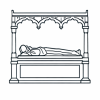
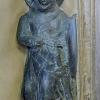
13th century church monuments
In the 13th century (c. 1200–1300), church monuments were effigial tombs, cross slabs, and early brasses, marking the birth of personalized commemoration in Early Gothic style. They emphasized feudal piety, crusading ideals, and prayers for the soul.
These 13th-century church monuments were formal, devotional, and hierarchical, Purbeck knights and cross slabs lay in rigid prayer, seeking salvation through status, stone, and supplication.
The transition from the 13th century (c. 1200–1300) to the 14th century (c. 1300–1400) marks a shift from Early Gothic rigidity to High Gothic elegance and realism, driven by wealth from wool trade, chivalric culture, and artistic innovation.
The late 13th to early 14th century (c. 1275–1325) is a pivotal hinge in English funerary art. Early Gothic rigidity gives way to High Gothic fluidity, driven by economic boom (wool trade), military innovation (plate armor), and artistic workshops gaining confidence.
French church monuments evolved in parallel with, but distinct from, England, shaped by royal centralization, Gothic architecture, Renaissance humanism, and religious wars. These French monuments were solemn, frontal gisants in limestone or Tournai stone, praying eternally in cathedral choirs, the foundation of Europe’s tomb tradition, born at Saint-Denis.