
Raising the Widow's Son - Brixworth, Northamptonshire
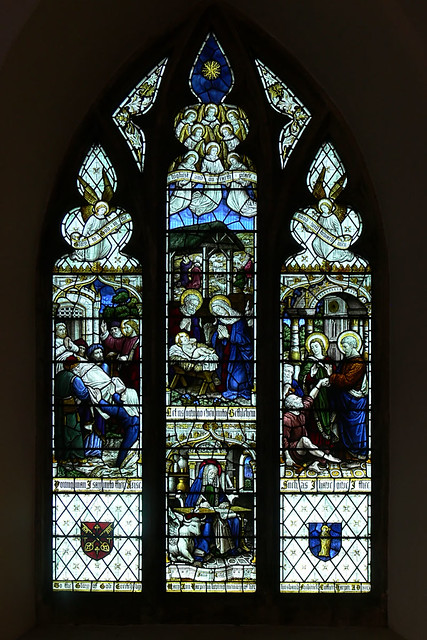
This three-light window combines New Testament narrative, apostolic witness, and charitable action, presenting a coherent theological programme centred on compassion, incarnation, and the transmission of faith.
Left-hand light:
The principal scene depicts the raising of the son of the widow of Nain, with Christ commanding “Young man, I say unto thee, arise” (Luke 7:14). The miracle emphasises Christ’s compassion for the vulnerable and his power over death, themes that resonate strongly within a parish setting. The figures are arranged to focus attention on the moment of restoration, with the widow’s grief transformed into hope.
Central light:
The upper panel shows the Nativity, accompanied by the inscription “Let us now go then unto Bethlehem” (Luke 2:15). Below, Saint Luke ⓘ is shown seated and writing his Gospel, establishing him as the authoritative witness to both the Incarnation and Christ’s acts of mercy. This pairing explicitly links sacred history to its textual transmission.
Right-hand light:
Saint Peter ⓘ and Saint John ⓘ are shown collecting alms, with the inscription “Such as I have give I thee” (Acts 3:6). The scene translates Christ’s compassion into apostolic action, presenting charitable giving as a living continuation of Christ’s ministry.
Tracery lights:
Above the three main lights, angels bearing a scroll proclaim “Glory to God in the highest, and on earth peace, good will towards men” (Luke 2:14), uniting miracle, Incarnation, and charity within a single hymn of praise.
The window is characteristic of Burlison & Grylls ⓘ’ early twentieth-century work, with clear narrative sequencing, carefully chosen scriptural texts, and restrained yet luminous colour. Installed in 1913, it reflects a sustained interest in pairing biblical narrative with moral instruction, presenting acts of mercy and generosity as central expressions of Christian faith within the life of the parish.