
Bryans, Herbert
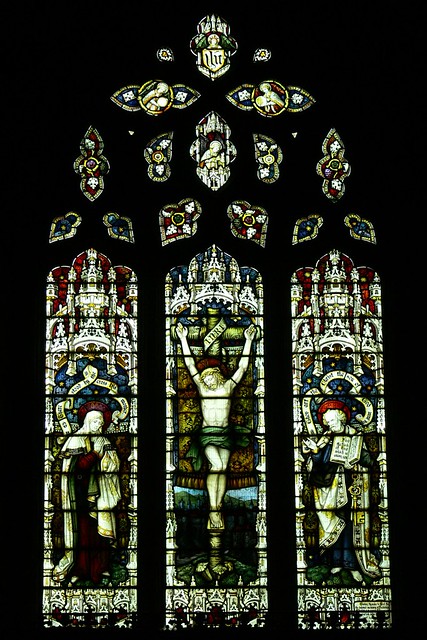
Herbert William Bryans was an English stained-glass artist active during the late Victorian and Edwardian periods, whose work represents a continuity of Gothic Revival principles into the early twentieth century. He trained within the influential studio of C. E. Kempe, one of the leading ecclesiastical designers of the later nineteenth century, and worked both as a student and as a designer within Kempe’s workshop. This formative experience shaped Bryans’s approach to stained glass, particularly his emphasis on strong drawing, rich but controlled colour, and clarity of iconographic narrative.
In 1897, Bryans established his own stained-glass business, marking his transition from studio designer to independent practitioner. Although working outside Kempe’s firm, his glass continued to reflect the stylistic discipline and ecclesiastical seriousness associated with the Kempe tradition. Figures are typically characterised by firm outlines, carefully modelled faces, and drapery treated in broad, legible folds, while architectural canopies and decorative details draw on established Gothic forms rather than experimental modernism.
Bryans’s work is found primarily in parish churches, where his windows often combine traditional biblical subjects with figures selected to reflect local dedications, patronage, or devotional emphasis. His compositions tend towards balance and restraint rather than dramatic intensity, aligning with Anglican tastes at the turn of the century that favoured reverent clarity over emotional excess. In this respect, Bryans occupies a position between the high Victorian Gothic revival and the more stylised developments of early twentieth-century stained glass.
Although less widely known than some of his contemporaries, Bryans played a significant role in sustaining the craft traditions of English stained glass during a period of transition. His career illustrates how artists trained within major late-nineteenth-century workshops continued to shape ecclesiastical art well into the new century, adapting inherited visual languages to changing contexts while maintaining continuity with established forms.


