Jean de Sachy Memorial - Amiens Cathedral.

This imposing wall memorial commemorates Jean de Sachy, a prominent merchant and alderman (échevin) of Amiens, who died in 1644. Executed by the sculptor Nicolas Blasset, the monument presents a richly layered Baroque composition structured as a classical architectural façade. Veined imitation-marble columns support an entablature and broken pediment, the latter containing the Sachy family arms flanked by winged skulls signalling mortality.
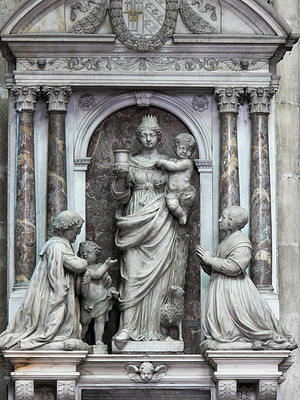
At the centre of the monument stands a crowned female figure identifiable as Charity (Caritas), the allegorical embodiment of Christian love. Her crown, classical dress, and attributes—a child supported in her right arm and a lidded vessel in her left—match the conventional iconography of Charity in seventeenth-century France. At her feet, to the right, stands a lamb, symbol of innocence, gentleness, and pastoral care, further reinforcing the virtue’s nurturing character.
To either side kneel the commemorated couple themselves:
-
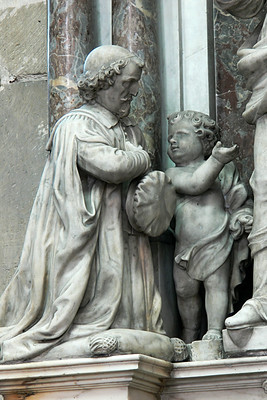
On the left is Jean de Sachy,
-
On the right, his wife,
both shown as mature adults in contemporary civilian dress. Their symmetrical devotional postures present them as models of piety and humility before the virtue presiding above. At Sachy’s side a putto or small child gestures upward toward Charity, guiding the viewer’s attention to the allegorical centrepiece. These children are allegorical, not portraits, and belong to the traditional imagery of Charity, who is often accompanied by multiple infants as symbols of maternal love and benevolence.
Beneath the main sculptural grouping lies the rectangular inscription tablet, which once recorded Sachy’s civic status, virtues, and benefactions.
The Allegory of Death
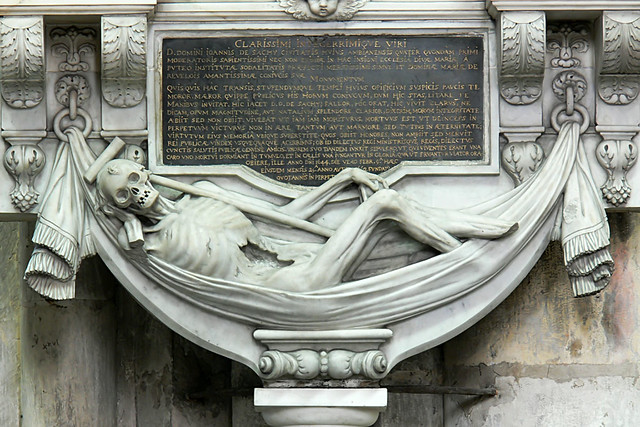
The lower register contains Blasset’s powerful “Allegory of Death”, one of the most striking memento mori sculptures of the period. A cadaver reclines in an oval recess, rendered with extraordinary anatomical realism: gaunt limbs, exposed ribs, and a slackened mouth. One hand stretches outward as though addressing or warning the living.
This figure forms the theological and emotional foundation of the whole composition. Positioned directly below Charity and the kneeling couple, it confronts the viewer with the inevitability of death and the futility of earthly rank. The monument thereby establishes a deliberate vertical progression:
virtue above → the faithful in prayer → death below.
The contrast between the serene allegory and the stark cadaver reflects Counter-Reformation devotional aims, urging repentance, moral reflection, and preparation for the Last Judgement.
Context
Nicolas Blasset served as the leading sculptor in Amiens during the mid-seventeenth century. His funerary works are characterised by an expressive naturalism combined with a controlled architectural vocabulary. The Sachy memorial exemplifies this regional Baroque idiom: a prominent citizen and his wife presented in humble devotion beneath the overseeing virtue of Charity and above an uncompromising image of death.
Such monuments were characteristic of the Picard bourgeois elite, who adopted Counter-Reformation allegories to express faith, status, and the hope of salvation. The inclusion of the spouse and the allegorical children emphasises family continuity and collective piety as central civic virtues.
Significance
The Jean de Sachy memorial is a major example of seventeenth-century funerary sculpture in northern France. Its combination of architectural grandeur, moral allegory, and intense realism places it among Blasset’s most accomplished works. The crowned figure of Charity provides the moral framework, the kneeling couple embody civic virtue and devotion, and the cadaver at the base delivers a powerful reminder of human mortality. Together, they form one of the most compelling sculptural ensembles in Amiens Cathedral.