

Romanesque statue and popular cult object since the Middle Ages, which legend says was carved by Saint Luke the Evangelist.
Romanesque statue and popular cult object since the Middle Ages, which legend says was carved by Saint Luke the Evangelist.
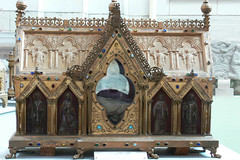
This shrine, shaped like a miniature Gothic church, was created to house the relics of early bishops of Cambrai–Arras. The richly ornamented structure is made of gilded copper alloy and decorated with coloured glass cabochons. A central rock-crystal window allowed the faithful to view the relics inside.

Set into a 13th century window, in the south ambulatory of the choir (bay 44) of Chartres Cathedral, this is one of the most celebrated medieval artworks in the Cathédrale Notre-Dame de Chartres.It dates primarily to c. 1180 CE, with later additions around 1225 CE, making it a rare survivor from the pre-1194 fire that destroyed the earlier Romanesque cathedral.
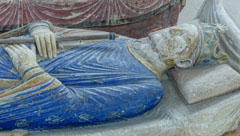
Tomb of King Henry II of England at Fontevraud Abbey, France.
 Designated a World heritage Site by UNESCO in 1979 the Cathedral of Notre-Dame de Chartres was built from between 1145 and 1250. It's high nave is spanned by ogival pointed arches to form the vault, and the walls are supported by double flying buttresses. Chartres is the first building to have used buttresses as a structural element.
Chartres Cathedral is also unique in having retained almost all of its original 12th and 13th century stained glass.

The south porch of Chartres Cathedral contains a series of sculptures, that were made between 1194 and 1230, on the subject of the martyrdom of saints.
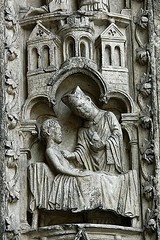
In addition to the martyrs, the south porch contains a sequence of images of those that had proclaimed Christian beliefs during periods of suppression (confessors).
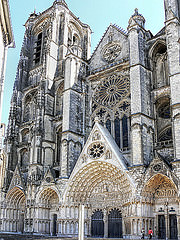
Construction of Bourges cathedral began in 1195 and was finally completed and dedicated to St Stephen in 1324. With its five portals the western façade, which was completed in 1230, is the widest of any Gothic church spanning some 40 metres.
The south side of the choir clerestory at Bourges Cathedral contains a remarkably complete early-Gothic cycle of New Testament figures, created between about 1200 and 1225. These tall, independent lancets depict apostles and evangelists in a unified iconographic programme, forming a deliberate counterpart to the Old Testament prophets on the north side of the choir.
The only New Testament figures not on the south side are those in the apex window, w.200 - the Virgin and Child with St Stephen — which stand on the north side and serve a special liturgical and dedicatory function.
In the 13th century (c. 1200–1300), church monuments were effigial tombs, cross slabs, and early brasses, emerging as Gothic art replaced Romanesque. They focused on piety, feudal status, and intercession, with stiff, symbolic figures.