15th century

'Wakeham' Cenotaph - Tewkesbury Abbey

'Wakeham' Cenotaph - Tewkesbury Abbey

Attributed to John Wakeham (d1549), the last abbot of Tewkesbury, the 'Wakeham' Cenotaph, actually mid fifteenth century and pre-dates the abbot by about 100 years. The effigy is a gisant as a decomposing corpse and the canopy was modelled on the throne of the House of Lords.

15th century church monuments

William Baghot Brass


In the 15th century (c. 1400–1500), church monuments, primarily effigial tombs and brasses, were the dominant form of commemorative art in parish churches and cathedrals. They reflected social status, piety, and late medieval chivalric culture, with a shift toward realism and personal expression.


15th century wooden Apostles - Dunstable Priory

15th century wooden Apostles - Dunstable Priory

These carved oak Apostles at Dunstable Priory form part of the structural and iconographic programme of the timber roof, functioning as corbels supporting arched braces or hammer-beams. Oak, the standard and most durable timber for English ecclesiastical roofs, was universally favoured for such work, allowing both structural strength and detailed carving.


Abraham, Sarah, and Isaac


This window in the St Anne Chapel, Malvern Priory, has twelve scenes depicting the Story of Noah and the Flood, and birth of Isaac . It is dated to between 1440-1450 and was probably the gift of Isabel Despenser and Richard de Beauchamp, 13th earl of Warwick.


The bottom register of the window shows four scenes from the story of Abraham , Sarah, and the birth of Isaac.

Adam and Eve and the Fall


This window in the St Anne Chapel, Malvern Priory, has twelve scenes depicting the Creation story and the Fall. It is dated to between 1440-1450 and was probably the gift of Isabel Despenser and Richard de Beauchamp, 13th earl of Warwick.


The middle register of the window illustrate the creation of Adam and Eve, the Forbidden Fruit, and the Fall.

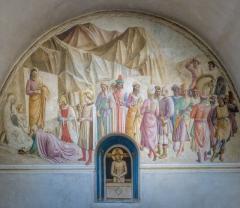
Adoration of the Magi (cell 39)

Adoration of the Magi (cell 39)

Cell 39 on the second floor of the San Marco convent was reserved for Cosimo de Medici. The fresco on the wall is the Adoration of the Magi by Benozzo Gozzoli .

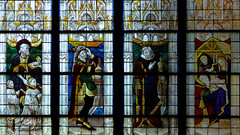
Adoration of the Magi - Bourges Cathedral

Adoration of the Magi

This window depicts the Adoration of the Magi, one of the most accomplished surviving examples of mid-15th-century glass painting in Bourges Cathedral. The composition unfolds across four lights beneath a framework of delicate Gothic canopies enriched with gilded tracery and pinnacles.

Annunciation (cell 3)

Annunciation (cell 3)

This Annunciation (1438-1443) frescoe, by Fra Angelico , is in cell 3 of the novice accommodation at San Marco Florence.

Baptism of Christ (cell 24)

Baptism of Christ (cell 24)

This fresco by Fra Angelico , painted between 1438 and 1443 for the Dominican monastery of San Marco, presents the Baptism of Christ with the clarity, stillness, and devotional intensity characteristic of the artist’s mature period. Set against a serene, winding Jordan River and a stark, mountainous landscape, the composition emphasises the humility of the moment and the contemplative ethos of the monastery for which it was made.

Pages

Subscribe to 15th century