
Crucifixion Fra Angelico - Chapter House, San Marco, Florence

This crucifixtion fresco (1441-1442) is by Fra Angelico ⓘ in the Chapter House of the San Marco monastery in Florence.
This crucifixtion fresco (1441-1442) is by Fra Angelico ⓘ in the Chapter House of the San Marco monastery in Florence.
Crucifixion frescoes by Fra Angelico ⓘ in the monk cells at San Marco monastery in Florence. These images are mainly in the cells for novices and were painted between 1438 and 1443 by Fra Angelico and his apprentices.
Crucifixion fresco (1441-2) by Fra Angelico ⓘ in cell 38 on the second floor of the San Marco convent.

This stained glass window (1467-1469) in the south wall of the Lady Chapel at Evreux Cathedral, depicts the Death of the Virgin Mary ⓘ in the upper registers.
This funerary monument depicts Don García Osorio, a knight of the Order of Santiago, shown in repose with hands crossed upon his sword, a symbol of both chivalric honor and Christian faith. Carved in Toledo (1499-1505), probably by a sculptor influenced by Egas Cueman or Sebastián de Almonacid.
Donato di Niccolò di Betto Bardi, known as Donatello, was one of the most innovative sculptors of the early Italian Renaissance. Active primarily in Florence, he transformed sculpture through radical naturalism, psychological intensity, and technical experimentation in marble, bronze, wood, and relief. His work broke decisively with late Gothic conventions and redefined the representation of the human figure, establishing sculptural languages that shaped Renaissance art in Italy and beyond.
Effigy of Donna Maria de Perea wearing a simple dress and with rosary in her hands.
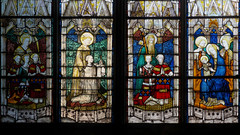
This window forms part of the Christological and donor cycle completed around 1467, stylistically linked to the Annunciation and Adoration of the Magi panels. The work is attributed to the Bourges Cathedral workshop, likely under Jean Lécuyer or André Robin, maîtres verriers active 1460–1475.
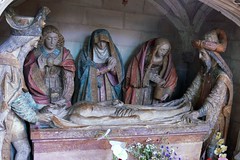 This, late 15th–early 16th century, Easter Sepulchre group depicts the moment of Christ’s entombment, a subject traditionally shown in Holy Week rituals in northern France and the Low Countries. The scene is arranged beneath a shallow architectural canopy, gathering together the key figures who, according to the Gospels, prepared Christ’s body for burial.


