16th century

16th century church monuments

In the 16th century (c. 1500–1600), church monuments transitioned from late Gothic to Renaissance styles amid the Reformation (1530s onward). Brasses dominated for the middle classes; alabaster tombs for elites. Meanwhile religious upheaval reduced overt Catholic imagery.
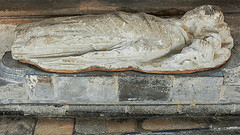
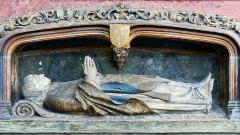
Abbot John Chambers - Peterborough Cathedral

Effigy of John Chambers (d1556) last abbot and first bishop of Peterborough. Described in the 17th century as being exquisitely carved, with a mitre and robe, and feet resting on a lion, this effigy was mutilated during the English Civil War.


Adrien Hénencourt monument - Amiens Cathedral

Adrien Hénencourt monument - Amiens Cathedral

Monument of Adrien Hénencourt (d1530) at Amiens Cathedral. This monument is below the choir screen (1490-1530) depicting the life of St Firmin that canon Hénencourt was responsible for commissioning.

Agnes Sorel Tomb- Loches, France

Agnes Sorel Tomb- Loches, France

Agnès Sorel (d1450) was the mistress of King Charles VII of France to whom she gave birth to three daughters to Charles VII.
 

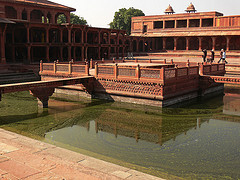
Anup Talao and Pavilion

Completed in 1576, the Anup Talao, or peerless pool, is in the Mahal-i Khass courtyard near to the Khwabgah (Royal apartments). Made of red sandstone this square water tank, has four bridges that lead over the water to a central platform surrounded by a jali balustrade.


Arnoult de Nimègue

Active: early to mid 16th century
Arnoult de Nimègue

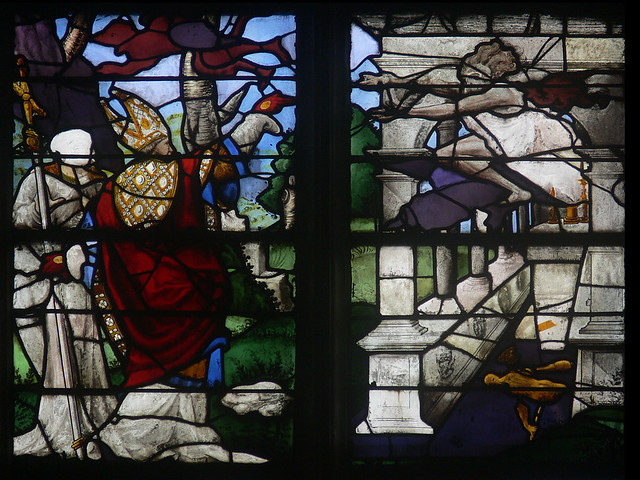
Arnoult de Nimègue was a stained-glass painter active in the early sixteenth century, whose name indicates an origin in Nimègue (Nijmegen) in the Low Countries. He is documented or attributed as working in France during a period of significant artistic transition, when Renaissance forms derived from Netherlandish and Italian sources were increasingly incorporated into French stained glass.

Ascension, Descent into Hell

Ascension, Descent into Hell

These panels from the 'Magnificat' window (1501) at Malvern Priory depict the Archangel Michael on the left. On the top right is Jesus ascent into Heaven, whilst the bottom right panel shows the damned descent into hell.


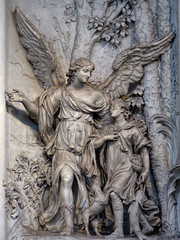
Baroque Sculpture

Raphael and Tobias Baroque sculpture, flourishing from the late 16th century to the early 18th century, is a vibrant and dynamic art form that emerged during the Counter-Reformation, particularly in Italy, to inspire faith and awe among the faithful. Characterized by its dramatic intensity, bold movement, and emotional depth, this style contrasts with the balanced harmony of the Renaissance.

Pages

Subscribe to 16th century