Mauméjean
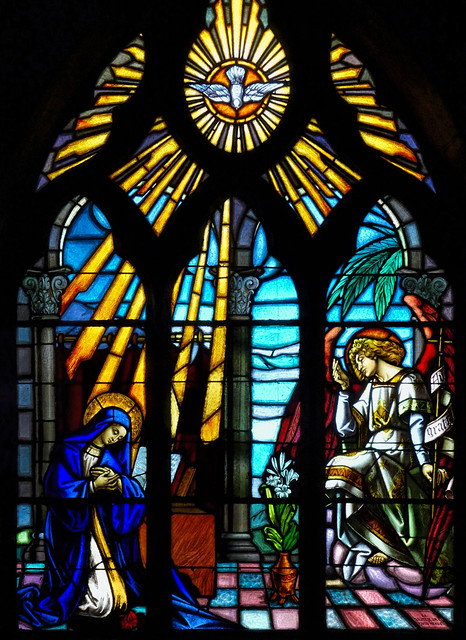
This vivid stained-glass depiction of The Annunciation, in the Church of Saint-Étienne at Déols, was produced by the celebrated workshop of Mauméjean Frères, whose work combined traditional sacred iconography with the structural clarity and stylised colour of early twentieth-century design.
The composition is organised around a strong vertical axis, dividing the scene between the Virgin Mary at prayer on the left and the Archangel Gabriel on the right. Above them, the Holy Spirit descends in radiant form, its golden rays spreading through the traceries of the window to flood the composition with divine light. The setting, defined by slender Gothic columns and an architectural canopy, evokes both the domestic interior and the celestial sanctuary. The angel’s sweeping gesture and the Virgin’s bowed head create a dialogue of humility and grace that captures the moment of incarnation with luminous simplicity.
Executed with the characteristic precision of the Mauméjean atelier, the figures are outlined in assertive black cames, while areas of translucent colour—sapphire, emerald, and gold—are balanced with clear, enamelled glass to maximise natural light. The interplay of strong contour and radiant tone reflects the workshop’s mature style: a synthesis of symbolist clarity and architectural rhythm, bridging the Gothic revival and the emerging aesthetic of Art Deco.
The Déols Annunciation demonstrates the Mauméjeans’ regional reach beyond their Basque origins, showing how their Parisian and Biarritz studios disseminated a unified aesthetic across France in the early decades of the twentieth century. The restrained harmony of this window exemplifies their philosophy that stained glass should serve both as narrative and as luminous structure — art integrated with architecture, devotion expressed through design.
Mauméjean Frères: The Studio and Its Legacy
Founded in Pau in 1860 by Jules-Pierre Mauméjean, the family firm expanded rapidly under his sons Joseph, Henri, and Charles, establishing workshops in Anglet and later Biarritz by the 1890s. Their mastery of colour and composition earned them the title of Master Glassmakers to King Alfonso XIII of Spain, and by the early twentieth century they were collaborating with leading architects of the Basque region and Catalonia, including Antoni Gaudí.
By this period, the Mauméjean Frères had opened studios in Madrid, Barcelona, and Paris, evolving a distinctive visual language that fused medieval symbolism with modern geometric structure. Their stained glass, found throughout France, Spain, and Latin America, is characterised by rich chromatic harmonies, stylised figuration, and a deep understanding of how coloured light interacts with sacred space.
The Annunciation at Déols thus belongs to a mature phase of the firm’s production — a period when traditional devotional themes were being reinterpreted through the clean lines, luminous fields, and dynamic compositions that anticipated the modern ecclesiastical aesthetic of the mid-twentieth century.