Great Malvern Priory

Site overview
Great Malvern Priory is a former Benedictine priory church whose architecture, stained glass, and monuments preserve a long and complex record of religious life from the Norman period to the present. Founded in the later eleventh century as a dependent cell of Worcester Cathedral Priory, the site occupies a position of early importance within the Norman monastic expansion in western England.
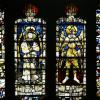
The origins of the priory were later associated with the hermit St Werstan, whose legendary foundation in the Malvern Woods was commemorated in the fifteenth century through the Founder’s Window (N.IV, c. 1445–1455). This narrative window presents the priory’s origins as they were understood in the late medieval period and forms a key point of reference for the site’s self-representation. While only individual panels are illustrated here, the surviving scenes demonstrate the prominence of foundation imagery within the glazing programme.
→ Stained glass at Great Malvern Priory
→ Founder’s Window (N.IV)
The medieval stained glass at Malvern survives alongside substantial nineteenth-century glazing, including windows by Kempe and Clayton & Bell ⓘ, introduced during Victorian restoration campaigns. In the late twentieth century the priory was further enriched by the Millennium Windows designed by Tom Denny, whose contemporary glazing engages directly with the scale, light, and iconographic traditions of the medieval building.
→ Tom Denny – Millennium WindowsIn addition to its glazing, Great Malvern Priory retains a significant body of medieval encaustic tiles, preserved in situ across parts of the church. These patterned floor tiles, decorated with heraldic, zoomorphic, and symbolic motifs, form an important component of the priory’s late medieval decorative scheme and contribute to the visual experience of the building at ground level.
Taken together, the architecture, stained glass, and monuments of Great Malvern Priory illustrate the continuity and adaptation of a historic religious site over nearly a millennium.
Early history
Great Malvern Priory has its origins in early medieval eremitic tradition. According to later legend, the hermit St Werstan fled persecution after escaping from Deerhurst Abbey, which was said to have been attacked and burnt by Danish raiders sometime in the ninth or tenth century. Guided by a vision in which angels led him to a secluded spot in the Malvern Woods, Werstan is said to have established a small chapel and hermitage on the site.
Following the Norman Conquest, St Wulstan, Bishop of Worcester, encouraged a monk named Aldwin to establish a small monastic community at the site traditionally associated with Werstan’s chapel. At this period the surrounding landscape formed part of Malvern Chase, a royal forest reserved for hunting, and was heavily wooded and sparsely settled. The land lay within the manor of Powick, which Edward the Confessor ⓘ had granted to his foundation at Westminster Abbey.
Aldwin and a small group of monks settled at Malvern, living a simple religious life in what was still largely wilderness. The priory was established as a dependent cell of Worcester Cathedral Priory, intended to house approximately thirty monks. The first stone church was considerably smaller than the present building. Important elements of this early phase survive, most notably the Norman Romanesque pillars and arches of the nave, which remain among the oldest standing fabric of the priory.
Later history and restoration
Following the Dissolution of the Monasteries in 1539, Great Malvern Priory entered a prolonged period of decline. Although the church continued in parochial use, much of the former monastic fabric fell into serious disrepair during the seventeenth and eighteenth centuries. By the early nineteenth century the building was widely described as semi-ruinous, prompting growing concern for its survival.
Restoration campaigns began in the early nineteenth century and continued intermittently through the 1860s. Contemporary descriptions record the severity of the priory’s condition prior to these works. Damage to the glazing in the north transept, including what is now known as the Magnificat Window, had allowed vegetation to penetrate the structure and enabled birds to enter the building; pigeons were reported to have nested within the transept. Plaster was falling from the walls, indicating prolonged neglect rather than deliberate alteration of the fabric.
→ Magnificat Window
Local tradition has occasionally attributed the removal of glass to the actions of a later vicar, but this appears to belong more to local folklore than to documented historical practice and cannot be substantiated by surviving evidence.
The nineteenth-century interventions, while extensive, ensured the survival of the medieval fabric and glazing and allowed the priory to continue in use as a parish church, providing the context for later Victorian and modern additions to the building.