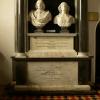
Stone, Nicholas
Nicholas Stone (1586–1647) was the leading English sculptor and master mason of the early seventeenth century, and the principal agent in the introduction of continental classical sculpture into England during the late Jacobean and Caroline periods.
Born in Devon, Stone trained in London before travelling to the Netherlands, where he worked under Hendrick de Keyser in Amsterdam. This experience exposed him to a sophisticated Northern European classicism rooted in Renaissance architectural theory and sculptural naturalism. On his return to England, Stone rapidly established himself as the foremost sculptor of elite monuments and architectural sculpture.
Stone’s work marks a decisive stylistic break from the late Elizabethan and Jacobean workshop tradition. His monuments favour clarity of proportion, architectural restraint, and naturalistic figure carving, often abandoning the rigid prayer tableaux and heraldic density of earlier English tombs. Instead, figures are presented with greater bodily presence and psychological individuality, integrated into coherent classical architectural frameworks.
In 1631 Stone was appointed Master Mason to King Charles I, placing him at the centre of royal artistic patronage during the Caroline period. His workshop supplied monuments, statues, and architectural sculpture for aristocratic patrons, cathedrals, and royal projects across England. Stone’s account books, unusually well preserved, provide rare documentary insight into sculptural practice, patronage, and workshop organisation in early Stuart England.
Nicholas Stone’s influence extends well beyond his own lifetime. Through his sons and pupils, and through the authority of his classical idiom, he laid the foundations for the later development of English sculpture in the seventeenth and eighteenth centuries.