
Christ blessing the children - Upper Boddington, Northamptonshire
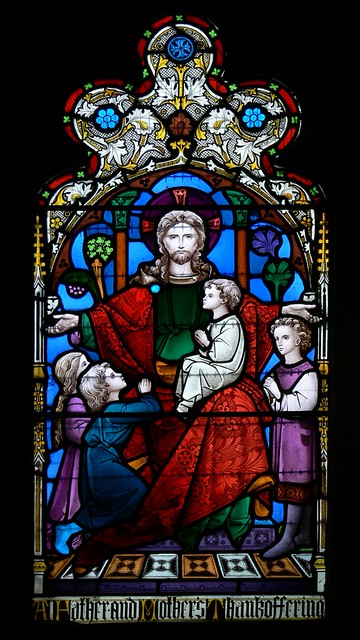
A devotional single-light window of the 1860s by Heaton, Butler & Bayne, depicting Christ blessing the children, a subject drawn from the Gospel narratives and closely associated with themes of innocence, vulnerability, and parental trust.
Christ stands centrally, his right hand raised in blessing, as children gather around him with gestures of openness and dependence. The composition is deliberately intimate in scale, encouraging personal contemplation rather than public spectacle. Above, an ornate Gothic canopy enriched with stylised foliage and floral motifs frames the scene, lending dignity and permanence to what is otherwise a quiet, pastoral moment.
An inscription along the base reads simply:
“A father and mother’s thank offering.”
The wording and anonymity of the dedication are striking. Unlike the majority of Victorian stained glass, which is typically explicit in naming donors or commemorating the dead, this window records no family name and offers no dates. The absence of a memorial formula suggests an act of thanksgiving rather than commemoration, pointing away from death and toward survival or deliverance.
Placed within its mid-nineteenth-century social context—marked by high infant mortality, frequent miscarriages, and the ever-present dangers of childbirth and childhood illness—the subject acquires particular resonance. Windows of this type are often understood as expressions of gratitude following the survival of a child, the safe delivery of a long-desired birth, or thanksgiving after earlier losses, even where those losses remain unspoken.
The decision to remain anonymous, especially in a commission of this expense, appears deliberate. It shifts emphasis away from social identity or public remembrance and toward a deeply personal devotional act. In doing so, the window resists the more overtly commemorative and status-conscious conventions of Victorian church patronage, instead giving material form to private parental anxiety, relief, and gratitude.
In both subject and inscription, the window stands as a rare and poignant example of stained glass used not as memorial or display, but as a restrained and enduring offering of thanks.