
Clutterbuck, Charles
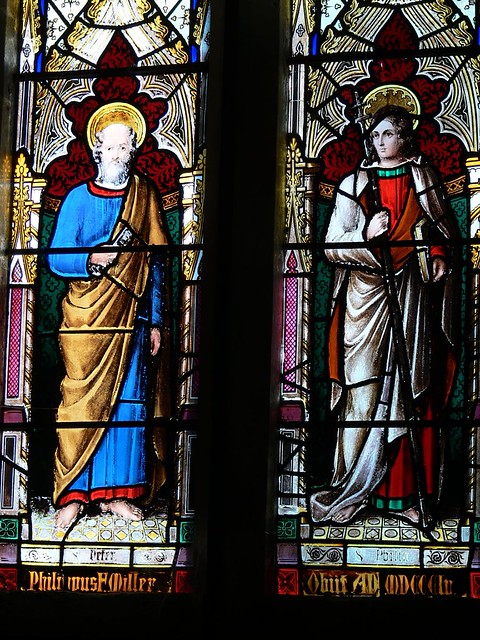
Charles Clutterbuck was an English stained-glass artist active in the mid-nineteenth century, working during the early phase of the Gothic Revival in ecclesiastical art. His work belongs to the formative period of Victorian stained glass, before the dominance of large commercial firms and the emergence of the fully developed High Victorian style.
Clutterbuck’s windows are characterised by clearly defined standing figures, strong linear drawing, and rich but controlled colour, with an emphasis on legibility and traditional iconography. Figures are typically presented beneath architectural canopies or against patterned grounds, reflecting contemporary ecclesiological taste and the revival of medieval visual language adapted to modern production.
Documentation for Clutterbuck’s career remains limited, and surviving works are relatively few, suggesting a modest output or a practice overshadowed by larger workshops later in the century. Nevertheless, his work contributes to the layered development of nineteenth-century English stained glass, occupying a transitional position between early Victorian revivalism and the more elaborate narrative glazing of the later period.
The featured example of his work is a mid-nineteenth-century window that depicts St Peter ⓘ and St Philip ⓘ, each presented as a standing figure beneath Gothic architectural canopies.
Left-hand light:
St Peter is shown holding the keys, the traditional emblem of his authority and role as the foundational apostle. His calm, frontal pose and clear attributes emphasise doctrinal clarity and apostolic continuity.
Right-hand light:
St Philip appears holding a cross-staff, identifying him as an apostle and martyr. The figure is slightly more animated in stance, but remains firmly within the disciplined compositional language of the period.
The window is characteristic of Charles Clutterbuck’s work of the 1850s, combining strong linear drawing, rich but controlled colour, and clearly legible iconography. The figures are set against patterned grounds and framed by architectural detail typical of early Victorian Gothic Revival stained glass, prioritising clarity and devotional function over narrative complexity.
Installed in 1855, the window represents an early phase of Victorian ecclesiastical glazing at Radway, preceding the later High Victorian and twentieth-century additions, and contributing to the layered visual history of the church.