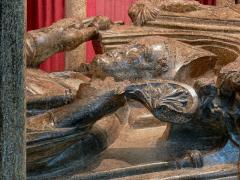
William I Duke of Normandy - Rouen Cathedral.
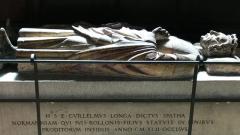
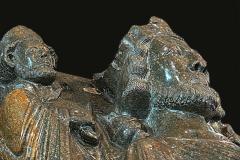
This tomb of William I Duke of Normandy (d942) in Rouen Cathedral dates from the 14th century. The earlier burial had been in the ancient sanctuary near the end of what is now the nave.
This tomb of William I Duke of Normandy (d942) in Rouen Cathedral dates from the 14th century. The earlier burial had been in the ancient sanctuary near the end of what is now the nave.
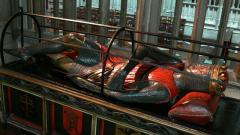
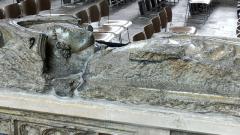
Robert Curthose ⓘ (d1134) effigy, of painted Irish bog oak, was made about 100 years after his death.
Tomb of King John the youngest son of Henry II and Eleanor of Aquitaine ⓘ. Made from Purbeck marble ⓘ the sarcophagus dates from about 1230 and is the earliest effigy in the country to an English king. Originally the effigy would have lain on the floor, but as more elaborate tombs were installed in later years, John's effigy was raised up to rest on a tomb chest that was made in about 1540.
Tomb of William Longespee (d1226) Earl of Salisbury. William Longespee was the illegitimate son of Henry II and half brother to King Richard I and King John of England ⓘ.
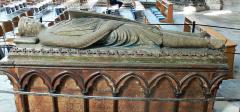
This effigy on a low tomb chest is thought to be Alexander of Holderness (d1226) abbot of Peterborough.
Two 13th century effigies of Benedictine monks. Peterborough Cathedral.
William de Kilkenny (d1256) monument. Bishop of Ely Cambridgeshire.
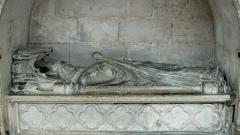
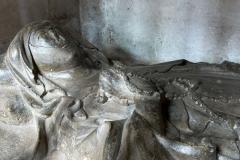
This tomb commemorates Gérard de Conchy ⓘ, Bishop of Amiens from 1247 until his death in 1257. The monument consists of a recumbent effigy carved in stone, representing the bishop vested in liturgical garments and wearing a mitre, his head resting on a cushion in the conventional manner of 13th-century episcopal tomb sculpture.
This finely carved effigy represents a 13th-century bishop, shown lying in state with hands raised in prayer. The figure is sculpted from dark Purbeck marble ⓘ, a material much used in English cathedrals of the period. The bishop is depicted wearing liturgical vestments, including the mitre and chasuble, and rests beneath an elaborately canopied tomb.
This mid 13th century tomb of Bishop Walter de Cantelupe (d1266) is made of Purbeck marble ⓘ. The relief of the effigy is more rounded than that of the nearby tomb of his predecessor the bishop of Worcester William de Blois (d1236) which is still in the Romanesque style and shows the development to the more rounded forms of the early Gothic.
Rollo (870 - 932) first Duke of Normandy. C20 copy of C13 effigy destroyed during the second world war.
This much mutilated, Purbeck marble ⓘ, effigy is of Bishop Walter de la Wyle ⓘ at Salisbury Cathedral.
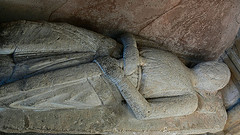 This thirteenth century effigy of a Knight dressed in chain mail and surcoat, is thought to be John de Verdun (d1274) a close supporter of King Henry III. The effigy is sculpted from Barnack Rag stone, and can be found in the Saxon church of All Saints Brixworth, Northamptonshire.
Sculpured panel of altar tomb depicting iconic "Lily Crucifixion", of which there are only two other stone sculptures in the UK.
Effigy of a lady from about 1300, thought to be a member of the Gifford family. This monument is under the Prince Arthur chantry chapel ⓘ.
Effigy of a cross legged knight ⓘ (c1305) thought to be that of Sir Robert Keynes.
The Tomb of Mabilia de Murdak (also spelled Mabilla or Mabila) is a small 14th-century medieval monument. The tomb is part of a collection of stone memorials in the north chapel (or Gayton Chapel), which includes effigies of local nobility tied to dramatic family events, such as murder and pilgrimage.
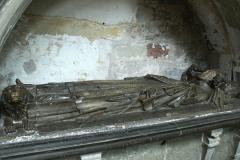
Defaced C14 effigy of priest on a chest tomb with quatrefoils.
Once thought to be an effigial monument to William Longespee (d1250) the date of the armour places this as a 14th century monument.
Purbeck marble ⓘ effigy of Bishop Thomas de Cobham (d1327). Worcester Cathedral.