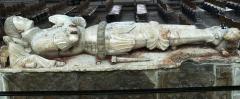
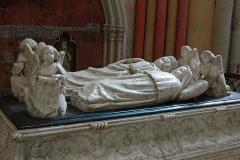
John Beauchamp of Holt and Wife - Worcester Cathedral
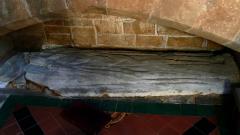
Tomb of John Beauchamp of Holt and his wife Joan. He was tried and convicted of treason by the Merciless Parliament in 1388, then hanged and beheaded at Tower Hill.
Tomb of John Beauchamp of Holt and his wife Joan. He was tried and convicted of treason by the Merciless Parliament in 1388, then hanged and beheaded at Tower Hill.
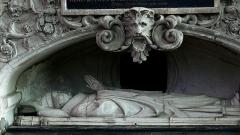
White marble effigy of Cardinal Jean de la Grange (d1402).
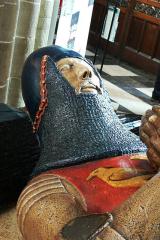
Tomb of William de Roos (d1414), 6th Baron Ros, 6th Baron Roos, Bottesford Leicestershire.
This two storied tomb for Richard de Beauchamp, 1st Earl of Worcester (d1421) was built in 1430 by his wife Lady Isabel le Despenser, the great grand-daughter of Edward III. It was probably meant to contain priant figures of both Richard, Isabel, and her second husband Richard de Beauchamp, 13th Earl of Warwick, who was her first husband's cousin.
Louis of Luxemboug (d1443). Brother of the governor of Paris who sold Joan of Arc to the English.
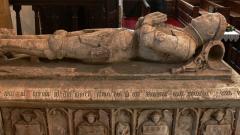
At Yelvertoft Northamptonshire is the tomb of John Dycson, who served as rector of Yelvertoft from 1439 to 1445, is a fine example of 15th-century English funerary art in the Perpendicular Gothic style. The monument consists of an alabaster effigy resting upon a low tomb chest, its sides richly decorated with panels of quatrefoils and other intricate tracery characteristic of the period.
Alabaster tomb of Sir John Cressy (d1445) Dodford, Northamptonshire. The sides of the tomb chest have angels holding shields, and the offices he held in France are listed around the top edge.
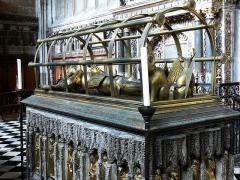
This is the tomb of Richard de Beauchamp, 13th Earl of Warwick. who died at Rouen on the 30th April 1439. His will made an endowment to the collegiate church ⓘ of St Mary, Warwick, money to build the chantry chapel ⓘ at St Mary's, and gifts to Tewkesbury Abbey.
This mid-fifteenth-century effigy depicts a priest shown vested for the celebration of Mass, carved in low relief and set beneath an architectural recess.
Attributed to John Wakeham (d1549), the last abbot of Tewkesbury, the 'Wakeham' Cenotaph, actually mid fifteenth century and pre-dates the abbot by about 100 years. The effigy is a gisant as a decomposing corpse and the canopy was modelled on the throne of the House of Lords.
This monument of an alabaster knight wearing Milanese armour is dedicated to Robert Lord Hungerford (d1464).
Bishop Ferry de Beauvoir (d1473). Amiens Cathedral France.
This carved alabaster monument of Bishop John Stanbury contains his effigy and has saints and angels as mourners carrying shields around all sides. Unfortunately the heads of the angels were chipped off during the reformation.
Lord John Cheney (d1499) was a Lancastrian supporter who in 1483 had supported the Duke of Buckingham's rebellion against Richard III. When Buckingham's rebellion failed he joined Henry Tudor in Brittany and returned with him from France in 1485.
Effigy of Donna Maria de Perea wearing a simple dress and with rosary in her hands.
This funerary monument depicts Don García Osorio, a knight of the Order of Santiago, shown in repose with hands crossed upon his sword, a symbol of both chivalric honor and Christian faith. Carved in Toledo (1499-1505), probably by a sculptor influenced by Egas Cueman or Sebastián de Almonacid.
Agnès Sorel (d1450) was the mistress of King Charles VII of France to whom she gave birth to three daughters to Charles VII.
The Tomb of the Children of France is a traditionally attributed to Michel Colombe ⓘ (c. 1430–1515), one of the foremost French sculptors of the late Gothic and early Renaissance periods, and is widely regarded as one of Michel Colombe’s most touching and refined works.
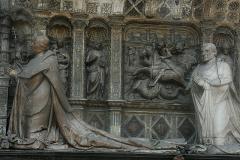
Started in 1515, and completed in 1525, this tomb is the work of the Roullant Le Roux, Rouen cathedral's master mason of the time. It is a memorial to the French cardinal and archbishop of Rouen George d'Amboise (d1510), the other figure is his nephew George d'Amboise (d1550) who became archbishop of Rouen on his uncle's death.
This tomb in the South choir contains the effigy of Bishop Richard Mayew (d1516) under an elaborate canopy, and with weepers ⓘ around the base. The weepers are thought to represent saints and were damaged during the reformation.