
Robert Lord Hungerford - Salisbury Cathedral

This monument commemorates Robert Hungerford, 3rd Baron Hungerford, and consists of a finely carved alabaster effigy of a knight wearing Milanese armour, lying recumbent upon a tomb slab.

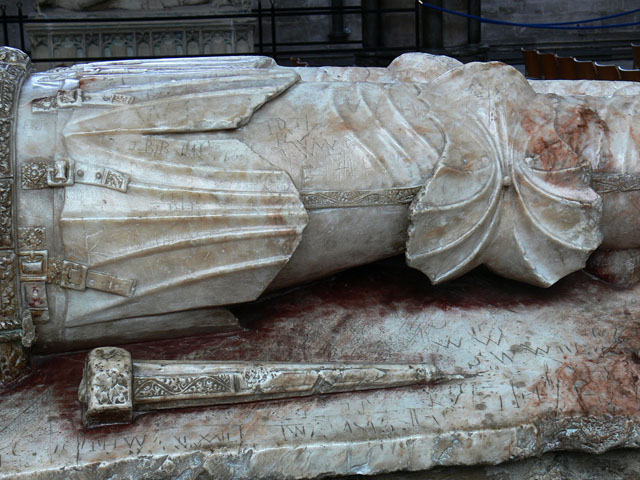
The armour is rendered with close attention to contemporary Italian plate forms, while the sword and belt fittings are treated with restrained decorative detail. Of particular significance is the Collar of Esses, worn prominently around the neck, identifying Hungerford as a committed adherent of the Lancastrian cause.

The effigy presents the baron in a posture of prayer, his head supported by cushions and his feet resting against a small animal, in keeping with mid-fifteenth-century aristocratic funerary conventions. The overall carving combines martial display with devotional stillness, a balance characteristic of English alabaster monuments of the later medieval period.
Historical context
Robert Hungerford played an active role in the political and military conflicts of mid-fifteenth-century England. He served as a commissioner of oyer and terminer in the aftermath of the Jack Cade’s Rebellion, and was among the councillors opposed to the rising led by Richard, Duke of York in 1452. Later that year he accompanied John Talbot, Earl of Shrewsbury to Aquitaine, where he was captured by French forces during attempts to relieve the siege of Châtillon in 1453. He remained a prisoner until 1459.
A steadfast supporter of Henry VI of England during the Wars of the Roses, Hungerford commanded the garrison of the Tower of London against Yorkist besiegers. Following the Lancastrian defeat at the Battle of Northampton, he was permitted to withdraw with Thomas Scales, Baron Scales. After a brief period abroad in Italy, he returned to England in early 1461 and fought at the Battle of Towton. Defeated, he fled north with Henry VI of England and Margaret of Anjou.
Hungerford was captured following the Lancastrian defeat at the Battle of Hexham and was executed at Newcastle on 18 May 1464. The monument’s emphasis on armour and the Collar of Esses underscores his identity as a loyal Lancastrian noble whose career—and death—were shaped by the civil conflicts of the Wars of the Roses.
