
Netherlandish panels - Radway, Warwickshire
These panels comprise a small but significant group of 17th-century Netherlandish stained glass, reused and recontextualised within the church at Radway. According to Pevsner, they were acquired in 1747 by Sanderson Miller for incorporation into his nearby Edgehill Tower, having previously been installed in a farmhouse in Dorset. They were later transferred to the chancel of the nineteenth-century church and finally reset in their present position in 1975, forming the east window of the south aisle.
The Unjust (Merciless) Steward
The first three panels illustrate episodes from the Parable of the Unjust (or Merciless) Steward:
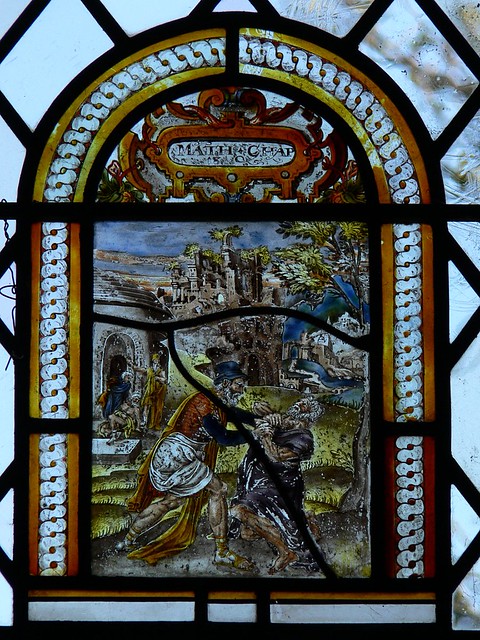
The steward choking a debtor, a vivid and moralising image emphasising cruelty and abuse of power.
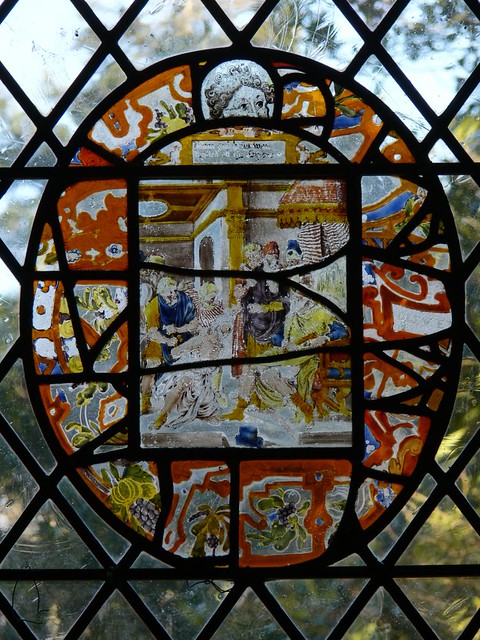
The steward brought before judgment, shown confronting authority; an English carved head placed above the panel underlines its later reuse and re-framing within an English context.
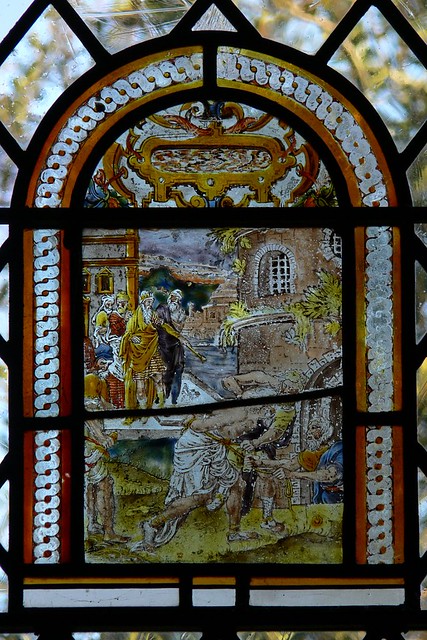
The steward led away to prison, completing the narrative arc from oppression to punishment.
The scenes are rendered with narrative immediacy, combining energetic gesture with detailed architectural and landscape settings typical of Netherlandish moral imagery of the period.
Jacob and Isaac
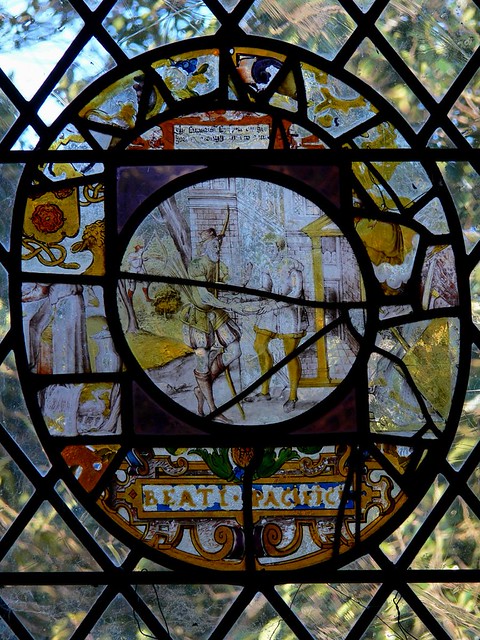
The fourth panel belongs to a different biblical narrative and depicts Jacob bringing meat to Isaac ⓘ, while Esau hunts in the background. The scene corresponds to Genesis 27 and is accompanied by the inscription Beati pacifici. As with the steward panels, the composition is genre-like in character, presenting the biblical episode through domestic action and carefully observed setting.
Interpretation and significance
These panels are not attributable to a named artist and should be understood as examples of antiquarian reuse, valued historically for their age, narrative content, and pictorial quality rather than for individual authorship. Their presence at Radway reflects eighteenth-century antiquarian taste, particularly the collecting practices of figures such as Sanderson Miller, and illustrates the complex afterlives of early modern stained glass as it moved between domestic, picturesque, and ecclesiastical settings.
Within the church, the panels function less as a unified iconographic programme than as historical survivals, layered into the fabric of the building and offering a rare glimpse of Netherlandish narrative glass of the seventeenth century preserved in an English parish context.