
Notre-Dame de la Blanche
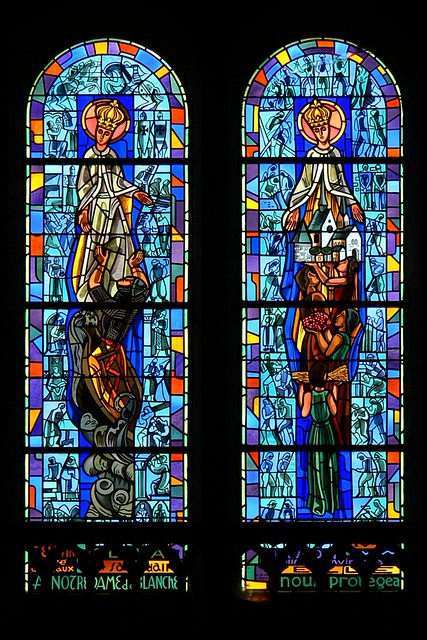
This two-light stained glass window, dated 1949, presents a modern devotional image of Notre-Dame de la Blanche, conceived in the years immediately following the Second World War. Designed by Gaston de Bodard and executed by the Orléans master-glazier Louis Gouffault, the window unites traditional Marian iconography with a meditation on conflict, protection, and historical continuity.
In the left-hand light, the Virgin stands above a soldier or knight who reaches toward her in appeal. Rendered in armour and shadowed tones, the figure evokes both the medieval combatant and the modern soldier, embodying a universal plea for mercy in times of war.
The right-hand light presents the Virgin as Protector of Pontlevoy, crowned and radiant, holding a model of the church in her arms. At her feet, women offer wheat and grapes, symbols of renewal, sacrifice, and the Eucharist.
In both panels, the surrounding mosaic-like fields—composed of angular shards of vivid blue, crimson, and gold—depict scenes of battle on either side. These fragmented vignettes of soldiers and knights in combat deliberately collapse medieval warfare and twentieth-century devastation into a single visual continuum, suggesting that human conflict persists across centuries while divine compassion endures.
The inscription along the base, « À Notre-Dame de la Blanche – priez pour nous », identifies the window as a votive offering of gratitude for the protection of Pontlevoy during the Second World War. The geometric precision of the composition, the crystalline rhythm of the leading, and the radiance of its colour exemplify Gouffault’s technical mastery and de Bodard’s expressive modernist vision.
The imagery resonates deeply with Pontlevoy’s layered identity as both a medieval abbey and a community shaped by modern warfare. By juxtaposing crusading knights with twentieth-century soldiers, the window articulates a continuity of human struggle across time. In this synthesis of sacred and martial imagery, the Virgin emerges as an enduring guardian: a figure of calm centrality amid conflict, transforming the window into a visual prayer for reconciliation, remembrance, and peace.