
Cheverny - St. Etienne church
This group of stained-glass windows at Saint-Étienne, Cheverny forms a coherent decorative and devotional scheme executed by the Tours-based glazier Julien Fournier in the later 19th century. Although each light is autonomous, their consistent scale, ornamental framing, palette, and figure types indicate a single campaign rather than piecemeal installation. The programme combines Marian theology, ecclesiastical hierarchy, martyrdom, and models of Christian authority.
The Annunciation

One window depicts the Annunciation, with the Virgin Mary ⓘ ⓘ kneeling at a prie-dieu as the Archangel Gabriel descends upon a cloud, the Holy Spirit appearing above in the form of a dove. The composition closely corresponds to a Fournier Annunciation at Pontlevoy, reused here with horizontal reversal and altered colour handling. This repetition reflects Fournier’s workshop practice of adapting established cartoons for multiple commissions, adjusting details to suit local lighting and context.
Saint Joseph and Saint Stephen
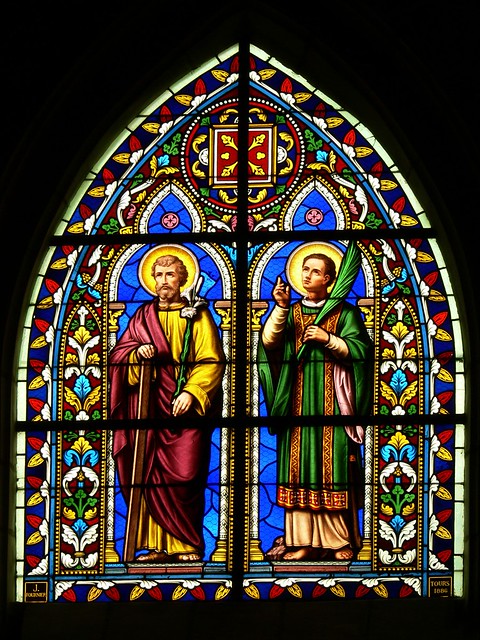
A standing male saint holding a lily and a carpenter’s plank is securely identifiable as Saint Joseph. The lily symbolises purity, while the plank refers to his trade. Shown beneath a Gothic canopy, Joseph represents domestic sanctity, obedience, and guardianship, themes strongly emphasised in 19th-century Catholic devotion. To the right a youthful saint holding the palm of martyrdom, identifying him as Saint Stephen ⓘ, the first Christian martyr. His inclusion is particularly appropriate, as the church itself is dedicated to Saint Stephen. The restrained iconography, using the palm alone rather than stones, reflects late 19th-century preferences for clarity and symbolic legibility.
Saint Germain of Auxerre and Saint Vincent of Saragossa
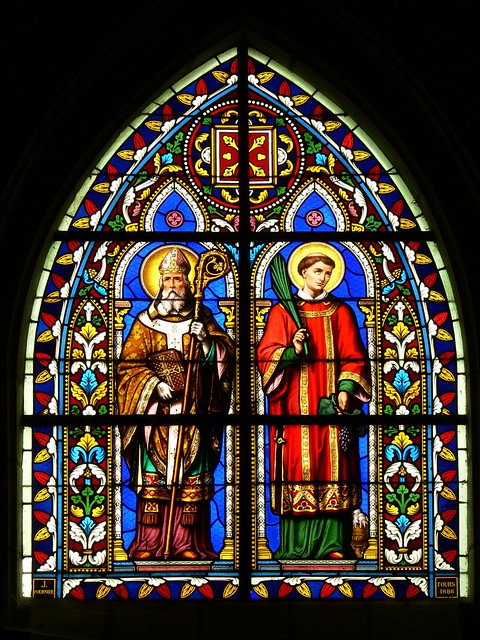
To the right is Saint Vincent of Saragossa ⓘ, shown as a youthful deacon and martyr, again holding the palm and bunch of grapes. Vincent’s cult was widespread in France, particularly in the wine growing regions. To the left an episcopal saint is shown with mitre and crozier who may be identified as Saint Germain of Auxerre ⓘ, a major Gallic bishop of the 5th century. Although no inscription survives, this identification is supported by iconography and by Fournier’s known practice of pairing Germain with Vincent in other glazing schemes. Germain represents episcopal authority, orthodoxy, and learning, and his inclusion situates the programme within a broader Gallic Christian tradition.
Saint Edmund, King and Martyr
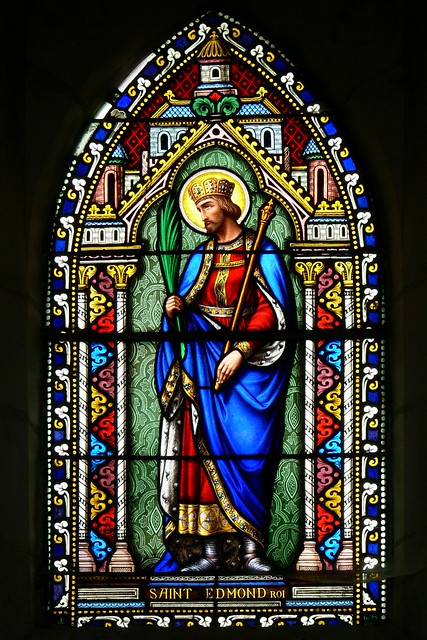
The final window depicts Saint Edmund the Martyr ⓘ, king of East Anglia, shown crowned and holding the palm of martyrdom, with the inscription SAINT EDMOND ROI. This is the only inscribed figure in the group, marking Edmund out as a saint whose identity might otherwise have been unfamiliar to a French congregation. Although an English royal saint, Edmund enjoyed a wide European cult and appears here as an exemplar of Christian kingship and martyrdom rather than as a figure of local historical relevance.
Interpretation
Taken together, the Cheverny windows form a carefully balanced programme. The Annunciation establishes the mystery of the Incarnation; Saint Joseph embodies domestic and obedient sanctity; Saint Stephen and Saint Vincent represent martyrdom within the ecclesiastical hierarchy; Saint Germain of Auxerre embodies episcopal authority and teaching; and Saint Edmund introduces the model of royal sanctity and sacrifice. The pairing of Edmund with Germain is particularly resonant, evoking a shared Christian history between Gaul and England and reinforcing themes of legitimate authority grounded in faith.
The reuse of cartoons, consistent Gothic framing, and selective inscriptional clarity are characteristic of Fournier’s late 19th-century parish work. At Cheverny, these elements combine to create a programme that is didactic, visually coherent, and firmly rooted in contemporary Catholic concerns with hierarchy, continuity, and sanctified authority.
