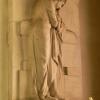
Behnes, William
William Behnes (1794–1864) was an English sculptor active in the first half of the nineteenth century, known for funerary monuments, portrait busts, and commemorative sculpture. Trained within the academic tradition of late Georgian neoclassicism, he developed a practice that combined formal discipline with a pronounced sensitivity to psychological expression.
Behnes’s work is characterised by controlled modelling, balanced compositions, and a restrained emotional register. In his funerary monuments, he frequently conveys grief and remembrance through posture, inclination, and drapery rather than through overt allegory or narrative symbolism. This approach aligns his work with the quieter neoclassical tradition associated with Chantrey and John Bacon the Younger ⓘ, rather than with the more theatrical tendencies of later Victorian sculpture.
Although his reputation was later overshadowed by more prominent contemporaries, Behnes played an important role in the continuity of neoclassical commemorative sculpture into the nineteenth century. His surviving monuments demonstrate a thoughtful engagement with form, space, and emotion, particularly suited to ecclesiastical settings.