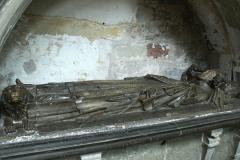
Defaced effigy of priest - Stanford-on-Avon, Northamptonshire.

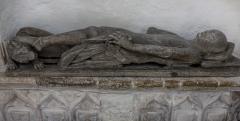
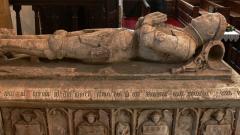
Defaced C14 effigy of priest on a chest tomb with quatrefoils.
Defaced C14 effigy of priest on a chest tomb with quatrefoils.
Once thought to be an effigial monument to William Longespee (d1250) the date of the armour places this as a 14th century monument.
Purbeck marble ⓘ effigy of Bishop Thomas de Cobham (d1327). Worcester Cathedral.
Tomb of Thomas de Savoie (d1337) with eight carved reliefs of weepers ⓘ or mourners.
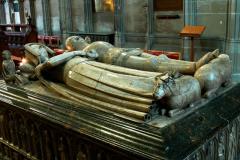
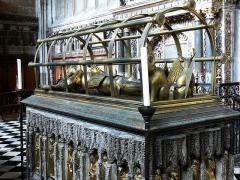
Tomb of King Edward II of England (d1327) in Gloucester Cathedral. It was commissioned by Edward III in 1336 and built in the early part of the 1340s.
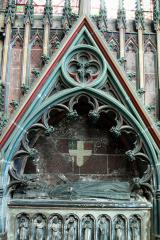
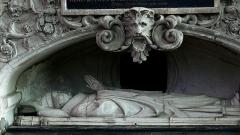
Mid C14 recumbent effigy of a priest in tomb recess.
This tomb of Hugh and Elizabeth, in the chancel of Tewkesbury Abbey, is of alabaster and the effigies are portraits of them both. The canopy once contained 26 statutes and was considered one of the finest in England.
This is one of fewer than 100 surviving wooden knight figures in England, and transcends mere memorial: it immortalizes Sir John's legacy as a minor but dutiful baron, who was possibly involved in Edward III's French campaigns
C14 effigy of priest in tomb recess.
Polychome tomb with effigy of baron Peter de Grandison (d1358) and the Coronation of the Virgin above the effigy.
Tomb of Thomas de Beauchamp (d1369) and his wife Katherine Mortimer.
Sir Richard Pembridge (d1375) was one of the earliest Knights of the Garter, being elected following the death of Thomas Ufford in 1368. He was present at all of Edward III's major victories during the Hundred Years War: Sluys (1340), Creçy (1346), the Siege of Calais (1347), and Poiters (1356) where he fought alongside the Black Prince.
White marble effigy of Cardinal Jean de la Grange (d1402).
Tomb of William de Roos (d1414), 6th Baron Ros, 6th Baron Roos, Bottesford Leicestershire.
This two storied tomb for Richard de Beauchamp, 1st Earl of Worcester (d1421) was built in 1430 by his wife Lady Isabel le Despenser, the great grand-daughter of Edward III. It was probably meant to contain priant figures of both Richard, Isabel, and her second husband Richard de Beauchamp, 13th Earl of Warwick, who was her first husband's cousin.
Louis of Luxemboug (d1443). Brother of the governor of Paris who sold Joan of Arc to the English.
At Yelvertoft Northamptonshire is the tomb of John Dycson, who served as rector of Yelvertoft from 1439 to 1445, is a fine example of 15th-century English funerary art in the Perpendicular Gothic style. The monument consists of an alabaster effigy resting upon a low tomb chest, its sides richly decorated with panels of quatrefoils and other intricate tracery characteristic of the period.
Alabaster tomb of Sir John Cressy (d1445) Dodford, Northamptonshire. The sides of the tomb chest have angels holding shields, and the offices he held in France are listed around the top edge.
This is the tomb of Richard de Beauchamp, 13th Earl of Warwick. who died at Rouen on the 30th April 1439. His will made an endowment to the collegiate church ⓘ of St Mary, Warwick, money to build the chantry chapel ⓘ at St Mary's, and gifts to Tewkesbury Abbey.
Attributed to John Wakeham (d1549), the last abbot of Tewkesbury, the 'Wakeham' Cenotaph, actually mid fifteenth century and pre-dates the abbot by about 100 years. The effigy is a gisant as a decomposing corpse and the canopy was modelled on the throne of the House of Lords.