
Denton family tomb - Hereford Cathedral

This alabaster monument to Alexander Denton and his wife Anne (nee Willison), dates from about 1566. Anne his wife and the child by her side are the only ones that are buried here.
This alabaster monument to Alexander Denton and his wife Anne (nee Willison), dates from about 1566. Anne his wife and the child by her side are the only ones that are buried here.

The roundels are late C15 to early C16. The figures of the donor family are mid C16 and probably come from Stanford Hall.
Alabaster memorial to Elizabeth Knightley (d1602). A recumbent effigy with somewhat brightly coloured decoration. All Saints, Norton, Northamptonshire.
Tomb of Francis Shirley of Staunton Harold (d1571), and his wife Dorothy.
Francis Tanfield was a member of a gentry family long settled at Gayton, Northamptonshire. The Tanfields held land in the county from at least the 14th century, and like many such families, maintained their position through estate management and service in local administration. Francis died in 1558, and his monument in St Mary’s Church was probably commissioned by his widow soon afterwards.
A colossal alabaster monument almost as high as the north wall. Includes a skeletal gissant at the bottom. Built in 1598 by Richard & Gabriel Royley ⓘ of Burton-upon-Trent.
Great Malvern Priory is a former Benedictine priory church whose architecture, stained glass, and monuments preserve a long and complex record of religious life from the Norman period to the present. Founded in the later eleventh century as a dependent cell of Worcester Cathedral Priory, the site occupies a position of early importance within the Norman monastic expansion in western England.
Henry Denton (1498) chaplain of Chelveston, a small village near to Higham Ferrers.
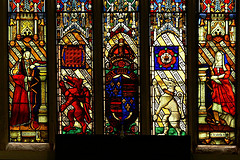
This remarkable window (1490-1505), rediscovered packed away in 1932, forms the lower section of the great east window at Stanford-on-Avon. It is one of the most striking survivals of late medieval royal propaganda in stained glass, created to celebrate the accession and legitimacy of Henry VII and the founding of the Tudor dynasty.

Set within the tracery lights of the great east window at St Peter’s ⓘ, Coughton, these panels form part of a distinguished group of Tudor heraldic glass. At the centre are the royal arms of Henry VIII, impaled with those of Catherine of Aragon, enclosed by the initials H and K and surrounded by the Tudor emblems of the rose, portcullis, and crown. The inclusion of Catherine’s arms confirms that the glass was installed before the annulment of their marriage in 1533, most likely during the first decade of Henry’s reign.


