Painted Clock - Raunds
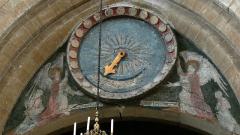
The painted clock a reminder of the passing of time ones mortality and the Last Judgment.
The painted clock a reminder of the passing of time ones mortality and the Last Judgment.
The medieval wall paintings in this section are allegories designed to promote the godly life over one of evil. Such paintings were also designed to show the fate that awaits anyone who does not heed the painting's warning.
Polychome tomb with effigy of baron Peter de Grandison (d1358) and the Coronation of the Virgin above the effigy.
Fom about 1420, the figures on the right are thought to be Louis II of Chalon, count of Saint Aignan, his mother, and his second wife Jeanne de Perellos.

Polychriome reliefs telling the story of St James the Greater, and the conversion of Philetus and Hermogenes. Amiens Cathedral 1511.
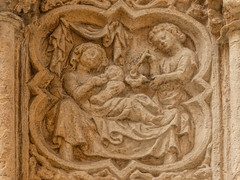
Quatrefoils dated 1278-1300, retelling Biblical stories carved around the Portail des Libraires of Rouen Cathedral.
The portal of St Firmin opens into the north aisle of Amiens Cathedral. The tympanum ⓘ shows the discovery of his remains outside the city, and their transport to the cathedral.
The tympanum ⓘ of St Stephen ⓘ at Bourges cathedral was constructed by 1240, and is above one of the five portals at the west end of the cathedral. The tympanum is made up of three sections. The lowest section depicts Stephen being made one of the seven deacons of the early church. Above that is his martyrdom, and on top of all is an image of Christ as Salvator Mundi.
 The portal of St Anne on the right of the western façade was built in 1200 and is the earliest of the three portals to be built. The tympanum ⓘ is actually dated to about 1150 and was once part of the earlier cathedral of St. Stephen ⓘ whose western façade was once 40 metres to the west of the present Cathedral.
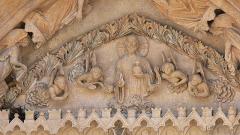
The central doorway was the last of the three portals, of Notre-Dame Cathedral Paris, to be decorated. Work started in about 1230 and consists of Christ in Majesty (showing the marks of the Crucifixion) with the Virgin Mary ⓘ and St John ⓘ on either side of him.