Ascension, Descent into Hell

These panels from the 'Magnificat' window (1501) at Malvern Priory depict the Archangel Michael on the left. On the top right is Jesus ascent into Heaven, whilst the bottom right panel shows the damned descent into hell.
These panels from the 'Magnificat' window (1501) at Malvern Priory depict the Archangel Michael on the left. On the top right is Jesus ascent into Heaven, whilst the bottom right panel shows the damned descent into hell.
This fresco by Fra Angelico ⓘ, painted between 1438 and 1443 for the Dominican monastery of San Marco, presents the Baptism of Christ with the clarity, stillness, and devotional intensity characteristic of the artist’s mature period. Set against a serene, winding Jordan River and a stark, mountainous landscape, the composition emphasises the humility of the moment and the contemplative ethos of the monastery for which it was made.
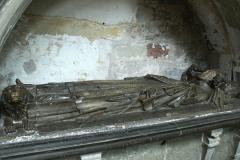
Two 13th century effigies of Benedictine monks. Peterborough Cathedral.
Bishop Ferry de Beauvoir (d1473). Amiens Cathedral France.
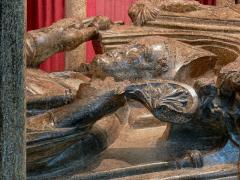
This finely carved effigy represents a 13th-century bishop, shown lying in state with hands raised in prayer. The figure is sculpted from dark Purbeck marble ⓘ, a material much used in English cathedrals of the period. The bishop is depicted wearing liturgical vestments, including the mitre and chasuble, and rests beneath an elaborately canopied tomb.
This carved alabaster monument of Bishop John Stanbury contains his effigy and has saints and angels as mourners carrying shields around all sides. Unfortunately the heads of the angels were chipped off during the reformation.
This tomb in the South choir contains the effigy of Bishop Richard Mayew (d1516) under an elaborate canopy, and with weepers ⓘ around the base. The weepers are thought to represent saints and were damaged during the reformation.
Purbeck marble ⓘ effigy of Bishop Thomas de Cobham (d1327). Worcester Cathedral.
This mid 13th century tomb of Bishop Walter de Cantelupe (d1266) is made of Purbeck marble ⓘ. The relief of the effigy is more rounded than that of the nearby tomb of his predecessor the bishop of Worcester William de Blois (d1236) which is still in the Romanesque style and shows the development to the more rounded forms of the early Gothic.
This much mutilated, Purbeck marble ⓘ, effigy is of Bishop Walter de la Wyle ⓘ at Salisbury Cathedral.