Salvator Mundi - Gloucester Cathedral

This window by Hardman & Co., illustrates a Salvator Mundi in the typanum, whilst below are three panels depicting St Agnes ⓘ, The Virgin Mary ⓘ, and St Dorothy.
This window by Hardman & Co., illustrates a Salvator Mundi in the typanum, whilst below are three panels depicting St Agnes ⓘ, The Virgin Mary ⓘ, and St Dorothy.
Tomb in memory of Sarah Baroness Braye (d1862) by Mary Thorneycroft ⓘ.
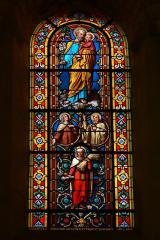
Dated 1887 this window of St Joseph, by Noel Lavergne, is in the church of Notre Dame la Blanche, Selles-sur-Cher.
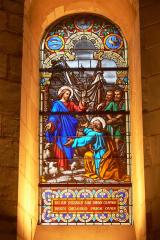
This window of St. Peter ⓘ receiving the keys of heaven, in the church of Notre Dame la Blanche, Selles-sur-Cher, is by Claudius Lavergne. The window is dated 1889 which is two years after Claudius Lavergne's death.

Main panel of this Hardman window illustrates Jesus delivering the Sermon on the Mount.
The south window of the chancel at All Saints, Middleton Cheney, contains two important stained-glass panels designed by Ford Madox Brown in 1870, created during his period of work for Morris, Marshall, Faulkner & Co. These windows are among the finest surviving examples of Brown’s contribution to Victorian ecclesiastical glass, characterised by his expressive figures, sculptural modelling, and dense narrative detail.

Stained glass by John Hardman in the church of St. Joseph Avon Dassett.

19th century stained glass of St. Leufroy (Leufredus) who was the founder of the Benedictine monastery at La-Croix Saint-Ouen, some 13km from Evreux. Leufroy grew up in Evreux and for a time was a teacher in the town.
The north-aisle east window at Middleton Cheney contains two major stained-glass figures designed by Ford Madox Brown in 1880 for Morris, Marshall, Faulkner & Co. These works represent some of Brown’s finest ecclesiastical contributions and exemplify his distinctive approach to figural design, which differs markedly from that of colleagues such as Burne-Jones ⓘ.
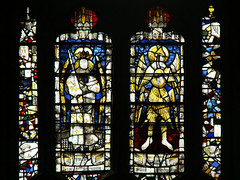
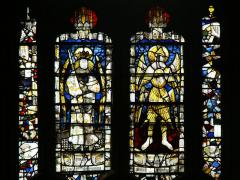
The stained glass of Great Malvern Priory survives in unusually varied condition and represents several distinct phases of glazing activity spanning the fifteenth century to the present day. Together, these windows form a layered visual record of patronage, devotion, restoration, and renewal within a single ecclesiastical site.