Worcestershire
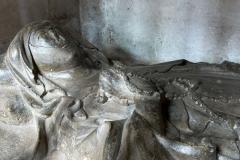
John Beauchamp of Holt and Wife - Worcester Cathedral
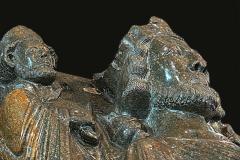
Tomb of John Beauchamp of Holt and his wife Joan. He was tried and convicted of treason by the Merciless Parliament in 1388, then hanged and beheaded at Tower Hill.
John Moore and Family - Worcester Cathedral
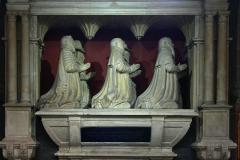
Monument to John Moore (d1613) and wife Anne. Worcester cathedral.
John of England Tomb - Worcester Cathedral
Tomb of King John the youngest son of Henry II and Eleanor of Aquitaine ⓘ. Made from Purbeck marble ⓘ the sarcophagus dates from about 1230 and is the earliest effigy in the country to an English king. Originally the effigy would have lain on the floor, but as more elaborate tombs were installed in later years, John's effigy was raised up to rest on a tomb chest that was made in about 1540.
Lady of the Gifford Family - Worcester Cathedral
Effigy of a lady from about 1300, thought to be a member of the Gifford family. This monument is under the Prince Arthur chantry chapel ⓘ.
Magnificat Window
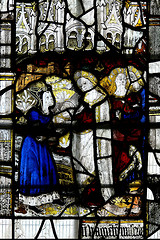
This window in the North transept of Great Malvern Priory was a gift from Henry VII in 1501. Containing scenes from the life of the Virgin Mary ⓘ and the life of Christ., it is known as the Magnificat window because it contains the Song of Mary from Luke 1:46-55.
Medieval stained glass
A substantial body of medieval stained glass survives at Great Malvern Priory, although its condition and completeness vary considerably from window to window. Several major fifteenth-century windows remain largely intact, most notably the Magnificat Window, the Founder’s Window, and the glazing of the Lady Chapel. Elsewhere, survival is more fragmentary: the great east window, though once a dominant feature of the church, now survives largely in dispersed panels and fragments rather than as a complete scheme.
Millennium windows
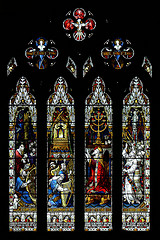
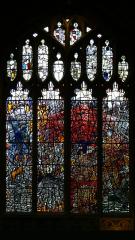
These two windows by Tom Denny, are inspired by Psalm 36, and were installed in Great Malvern Priory in 2003.
Noah and the Flood
This window in the St Anne Chapel, Malvern Priory, has twelve scenes depicting the Story of Noah and the Flood, and birth of Isaac ⓘ. It is dated to between 1440-1450 and was probably the gift of Isabel Despenser and Richard de Beauchamp, 13th earl of Warwick.
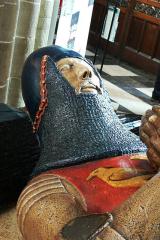
The top register of the window shows four scenes from the story of Noah and the flood.