
Andrews Tomb, Church Charwelton - Northamptonshire

Tomb of Sir Thomas Andrews (d1564) and his two wives, Katherine and Mary.
Tomb of Sir Thomas Andrews (d1564) and his two wives, Katherine and Mary.
 Ango Saxon sculpture is divided into two main periods, that before the 9th century Danish invasion and that after King Alfred (871-899). The period covers a period from the earliest Christian crosses, and includes stone decorative elements in churches depicting grotesque animals and fiugures intertwined with vine tendrils.
Examples of the friezes and fragments of stone carvings from the 8th century Anglo Saxon monastery at Breedon-on-the-Hill.
This chantry chapel ⓘ to Arthur Tudor, covered in tracery and sculptures, was built in 1504. The chest tomb of the 15 year old Prince fills the chapel.
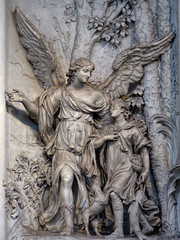 Baroque sculpture, flourishing from the late 16th century to the early 18th century, is a vibrant and dynamic art form that emerged during the Counter-Reformation, particularly in Italy, to inspire faith and awe among the faithful. Characterized by its dramatic intensity, bold movement, and emotional depth, this style contrasts with the balanced harmony of the Renaissance.
Two 13th century effigies of Benedictine monks. Peterborough Cathedral.
Architectural monument to commemorate members of the Benson family c1730. Probably by Smith of Warwick ⓘ.
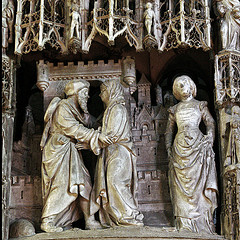
The first sequence of sculpture around the choir screen, starting at the western end of the south ambulatory, is the work of Jehan Soulas from 1519-1521. Sculpted from the hard limestone from the Tonnerre quarry, they consist of scenes from the Gospel of James, depicting the annunciation of the Virgin Mary ⓘ to Joachim and St Anne, the birth of Mary, and the presentation of Mary in the temple.
Bishop Ferry de Beauvoir (d1473). Amiens Cathedral France.
Bust of Bishop John Gaugen (d1662), Worcester Cathedral. John Gaugen was made Bishop of Worcester in May 1662 but died in September 1662 of "stone and strangury" - a complication of kidney stones.


