
Index of Medieval Sculpture
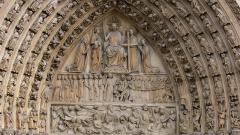
Gothic tympanum of the Last Judgement dating from about 1230 at Bourges Cathedral, France.

Tomb of William Longespee (d1226) Earl of Salisbury. William Longespee was the illegitimate son of Henry II and half brother to King Richard I and King John of England.

This effigy on a low tomb chest is thought to be Alexander of Holderness (d1226) abbot of Peterborough.

The central doorway was the last of the three portals, of Notre-Dame Cathedral Paris, to be decorated. Work started in about 1230 and consists of Christ in Majesty (showing the marks of the Crucifixion) with the Virgin Mary and St John on either side of him.
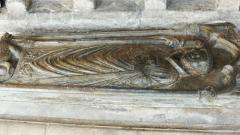
Bishop of Worcester 1218-1236. The effigy on the tomb is in the Romanesque style and lacks the detailed modelling that would become the hallmark of Gothic sculpture.

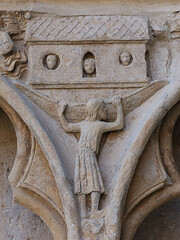
Decorated in about 1240 the spandrels below the portal of St Stephen at Bourges Cathedral contain sculpures depicting the story of Noah.
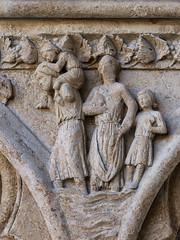
Sculpture of Old Testament stories in the spandrel on the Western facade of Bourges Cathedral.
Two 13th century effigies of Benedictine monks. Peterborough Cathedral.
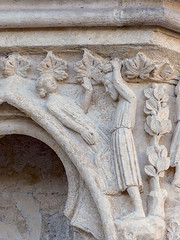
The biblical story of Cain and Abel in the spandrels of Bourges Cathedral.
The tympanum of St Stephen at Bourges cathedral was constructed by 1240, and is above one of the five portals at the west end of the cathedral. The tympanum is made up of three sections. The lowest section depicts Stephen being made one of the seven deacons of the early church. Above that is his martyrdom, and on top of all is an image of Christ as Salvator Mundi.


Made between 1240-1255 by a Paris goldsmith, to hold the relics of St Taurin, this shrine was commissioned by the abbot Gislebert de Saint-Martin. The reliquary weighs 82kg and is made of bronze silver and gold leaf over a wooden chest.

Decorated in about 1240 the spandrels below the north portal contain sculpures depicting the Creation.
Monument to Robert de Harcourt (d1205). The effigy of a cross legged knight is mid 13th century.
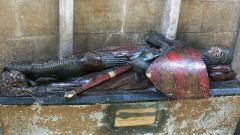
William de Kilkenny (d1256) monument. Bishop of Ely Cambridgeshire.

This tomb commemorates Gérard de Conchy, Bishop of Amiens from 1247 until his death in 1257. The monument consists of a recumbent effigy carved in stone, representing the bishop vested in liturgical garments and wearing a mitre, his head resting on a cushion in the conventional manner of 13th-century episcopal tomb sculpture.

This mid 13th century tomb of Bishop Walter de Cantelupe (d1266) is made of Purbeck marble. The relief of the effigy is more rounded than that of the nearby tomb of his predecessor the bishop of Worcester William de Blois (d1236) which is still in the Romanesque style and shows the development to the more rounded forms of the early Gothic.

Rollo (870 - 932) first Duke of Normandy. C20 copy of C13 effigy destroyed during the second world war.
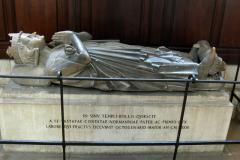
This much mutilated, Purbeck marble, effigy is of Bishop Walter de la Wyle at Salisbury Cathedral.

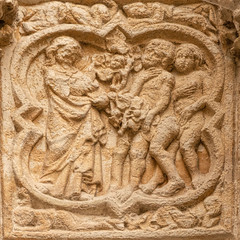
Located on either side of the Portail des Libraires at Rouen Cathedral, these quatrefoil sculptures of Adma nd Eve and their expulsion from Eden were created between 1278-1300.
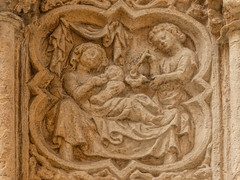
Quatrefoils dated 1278-1300, retelling Biblical stories carved around the Portail des Libraires of Rouen Cathedral.