
Index of all all
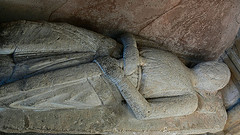 This thirteenth century effigy of a Knight dressed in chain mail and surcoat, is thought to be John de Verdun (d1274) a close supporter of King Henry III. The effigy is sculpted from Barnack Rag stone, and can be found in the Saxon church of All Saints Brixworth, Northamptonshire.
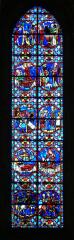
This tall lancet window (c. 1300) os one of two windows that presents a compact cycle of the Life of St Martin, arranged in five horizontal registers, each split into two quatrefoil medallions. The sequence highlights Martin’s charity, his spiritual trials, his episcopal authority, and his miraculous power as missionary and bishop. The glass is characteristic of the early 14th century at Tours, with intense blues and reds, crisp linear painting, and lively narrative detail.
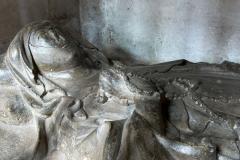
Eroded stone effigy of Lady c1300.

Sculpured panel of altar tomb depicting iconic "Lily Crucifixion", of which there are only two other stone sculptures in the UK.

Effigy of a lady from about 1300, thought to be a member of the Gifford family. This monument is under the Prince Arthur chantry chapel.
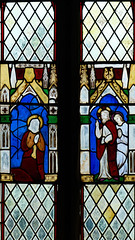
This fragmentary but evocative window from Holy Cross Church, Pattishall, preserves elements of a 14th-century English stained glass narrative cycle. The surviving lights depict a kneeling orant figure with hands raised in prayer, and beside it, a group showing Christ with a disciple or saint, set beneath delicately painted Gothic architectural canopies.

In the 14th century (c. 1300–1400), church monuments were primarily effigial tombs, brasses, and cross slabs, rooted in Gothic art and feudal piety. They emphasized chivalry, prayer, and heraldry, with growing realism in dress and armour.
Effigy of a cross legged knight (c1305) thought to be that of Sir Robert Keynes.

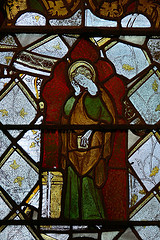
Early C14 fragments of stained glass re-set into north chancel window. St. Wilfred, Old Arley, Warwickshire
The Tomb of Mabilia de Murdak (also spelled Mabilla or Mabila) is a small 14th-century medieval monument. The tomb is part of a collection of stone memorials in the north chapel (or Gayton Chapel), which includes effigies of local nobility tied to dramatic family events, such as murder and pilgrimage.

Defaced C14 effigy of priest on a chest tomb with quatrefoils.

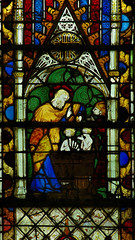
The surviving panels from Baies 12 and 14 of Saint-Ouen in Rouen preserve fragments of a once extensive fourteenth-century cycle devoted to St Bartholomew, one of the Twelve Apostles and the legendary evangeliser of the East. Although the scenes are today divided between two windows and have undergone significant later restoration, they retain the expressive line, saturated colour, and elegant architectural framing characteristic of the Rouen workshops between 1325 and 1339.
Once thought to be an effigial monument to William Longespee (d1250) the date of the armour places this as a 14th century monument.

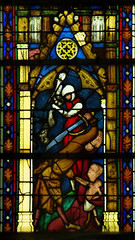
These two stained-glass panels from the choir clerestory of St Ouen form a paired narrative of the Massacre of the Innocents, rendered in the incisive and highly expressive manner characteristic of the early 14th-century Norman workshops. Though each panel stands within its own Gothic architectural frame, complete with gabled canopies, foliate bosses, and alternating bands of strong primary colour, the scenes are conceived as a continuous episode of violent disruption, unfolding across two moments of the same biblical tragedy.

The flagellation of St. Margaret of Antioch. Ashby St. Ledgers, Northamptonshire.
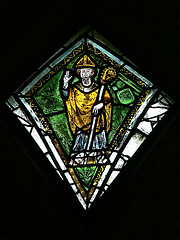
These two mitred abbots are from about 1327-1330, and can seen in the tracery of the east window of St Nicholas, Stanford-on-Avon, Northamptonshire.
Purbeck marble effigy of Bishop Thomas de Cobham (d1327). Worcester Cathedral.
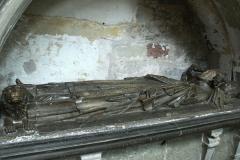
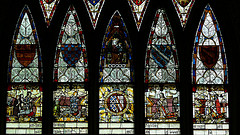 St Nicholas parish church in Stanford on Avon, Northamptonshire, contains a large amount of stained glass dating from c1330 - 1540. The early glass contains images of Saints and Bishops, whilst the later glass contains Netherlandish roundels, and images of the Cave family that were the donors.
After the execution of Hugh Despenser his remains were gathered together and buried here in Tewkesbury. The tomb once contained over 40 statues, all of which have now gone. The current tomb in the alcove is that of Abbot John Cotes (d1337) which was moved into this location in the 17th century.

Tomb of Thomas de Savoie (d1337) with eight carved reliefs of weepers or mourners.
